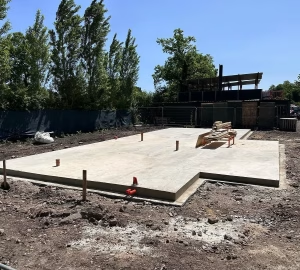
In some construction situations, standard concrete is more than adequate and will provide exactly what is required as a building material.
For instance, plain concrete is often used for pavements because it is highly durable under foot and as it is at ground level it doesn’t need the same ability to withstand other stresses that you want from a material used for a building.
Standard concrete is described as being resistant to compressive forces, which means it works well as a surface on a stable base.
However, in situations where you are constructing buildings or structures that need to be well supported, such as bridges or tunnels, plain concrete isn’t strong enough and doesn’t respond well to what’s known as tensile stress.
Why is reinforced concrete better at handling loads and tensile stress?
Plain concrete is a brittle material on its own. But reinforced concrete, which combines standard concrete with steel rods, wire mesh or cables, is much better able to resist a range of forces.
This is why it is suitable for use in buildings, as well as tunnels, bridges and many other areas of construction.
When the concrete dries around the steel formwork, it creates a bond that allows the metal and concrete to act as one structural element and therefore become considerably stronger.
The reinforcement provided by the steel formwork allows the structure to resist those tensile forces, while the concrete itself offers resistance to compressive forces. Together, they create a building material that is both versatile and strong.
What are the other benefits of reinforced concrete?
Other advantages of reinforced concrete include the fact that it is a very low maintenance material once it has set and that its thermal mass makes it naturally fire resistant.
It is also a highly durable material, which is why it is used for many structures that are exposed to the elements, as well as structures that need to stand the test of time.