Every construction project has its own unique requirements. Whether it is location-based or has architectural challenges for a formwork company, the concrete required will need to be a specific shape and size.
For concrete formwork, that means every project needs a different frame or container in the desired shape for the poured concrete.
The frame material can be made of timber, plywood, aluminium, steel or plastic.
What Are The Advantages Of Different Concrete Formwork Materials?
Timber Formwork
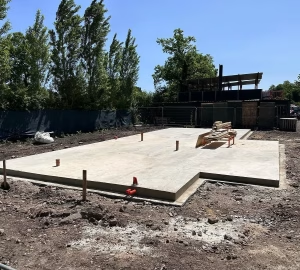
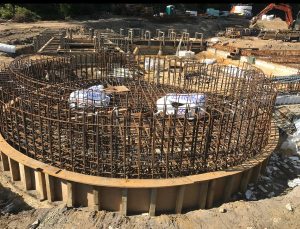
Useful for smaller projects such as home basements and foundations, it is also useful for complex shapes like circles. Made of timber planks, it is adaptable and was one of the first materials used to cast concrete formwork.
Timber formwork frames are relatively easy to create, making them an economical choice for small projects. They can’t always be used again but they are easy to remove and dispose of.
Plywood Formwork
Panels of plywood are commonly used on concrete formwork projects alongside timber frames. It has the advantage of providing a smooth surface for an even finish, so it looks good for unfinished walls and a minimalist aesthetic in homes.
It has many of the qualities of a timber frame; however, it can also be damaged easily, can weaken and warp when exposed to too much rain. Therefore, it must be handled with care or risk damage to the final concrete form.
Steel Formwork
Steel is often used for large-scale projects that require heavy loads. It is reusable but comes at a much higher initial cost than wood frames with much less flexibility for shapes.
Due to its weight, it may need a crane or other lifting equipment to install. It does provide a high quality, very smooth finish.
Formwork made with steel is perfect for pre-cast and repeating shapes in projects, for example retaining walls and road infrastructure.
Aluminium Framework
Much like steel, aluminium provides a smooth surface on the set concrete. However, it is much lighter than steel. It is faster to assemble and remove, making it ideal for projects where efficiency is important.
Compared to steel, it has a lower load-bearing capacity, but it is just as reusable and durable.
Plastic Formwork
While not suited for larger projects, plastic shapes can be reused. The disadvantage is that they can’t take the same weight as metal frames. Their main advantage is that they are lightweight and easy to move and install.
Plastic is usually more expensive than building a timber formwork, but it does give a smoother finish.
For advice on concrete formwork and which methods are best suited to your project, contact us to speak to one of our professional contractors.